|
|
Welcome to the website of the
Global Phosphorus Research Initiative (GPRI)
The GPRI is a joint initiative between the Institute for Sustainable Futures at the University of Technology, Sydney (UTS), and the Department of Water and Environmental Studies at Linköping University, Sweden. The main objective of the GPRI is to facilitate quality interdisciplinary research on global phosphorus security for future food security. In addition to research, the GPRI also facilitates networking, dialogue and awareness raising among stakeholders and the community on global phosphorus scarcity and possible solutions.
|
|
Phosphorus (P)
Phosphorus is an essential nutrient for all plants and animals. We get our phosphorus through the food we eat, which has been fertilized by mineral or organic phosphorus fertilizers. But where the phosphorus in our food comes from and how sustainable it is in the long term is often not the topic of debate or significant investigation.
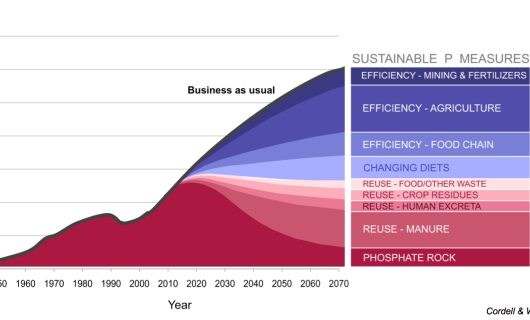
Modern agricultural systems are dependent on continual inputs of phosphorus fertilizers processed from phosphate rock. Yet phosphate rock, like oil, is a non-renewable resource that takes 10-15 million years to cycle naturally. While all farmers need access to phosphorus, just 5 countries control around 90% of the world’s remaining phosphate rock reserves, including China, the US and Morocco (which also controls Western Sahara’s reserves). Studies suggest current high-grade reserves will be depleted within 50-100 years. Further, peak phosphorus could occur by 2030. While the exact timing might be disputed, it is widely accepted that the quality of phosphate rock is decreasing and costs increasing. In mid 2008 the price of phosphate rock reached a peak 800% higher than early 2007.
The phosphorus situation has many similarities with oil, yet unlike oil, there is no substitute for phosphorus in food production. Phosphorus cannot be manufactured, though fortunately it can be recovered and reused over and over again.
click here to read 8 reasons why we need to better manage our global phosphorus resources for sustainable food production.
GPRI (2008)
|
|